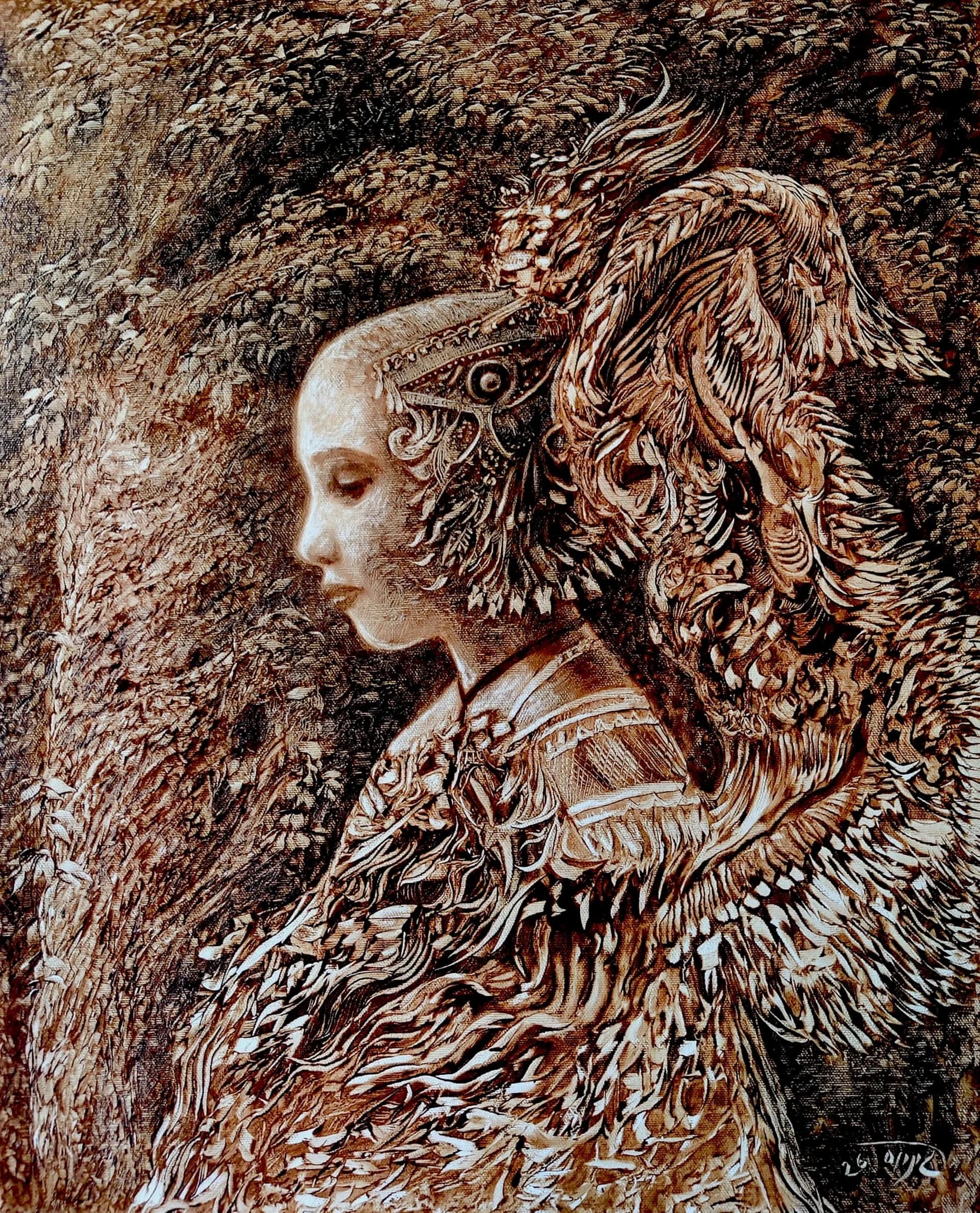
Eastern Bride
Eastern Bride presents a serene feminine figure emerging from an intricate world of feathers, leaves, flowing forms, and hidden symbols. Her face appears calm and timeless, while the elaborate textures surrounding her blur the boundary between woman, nature, and imagination. The composition invites the viewer into a realm where beauty is not merely seen, but discovered through layers of detail and symbolism. Embedded throughout the work are motifs that encourage deeper exploration: a watchful eye, mythical creatures, organic patterns, and ornamental forms that seem to transform into one another. Rather than offering a single narrative, the painting creates a space for personal interpretation, allowing each viewer to uncover their own meaning within its countless details. Rendered in rich earth tones and intricate textures, Eastern Bride is a meditation on beauty, mystery, femininity, and the enduring power of imagination.

Pinchas Eliyahu
Born in Havana in 1975, the artist grew up in a complex environment where art served both as an escape and a form of expression within a politically restrictive reality. At the age of 10, his exceptional talent was recognized by his teachers, who recommended him for a special program for gifted students. Through this, he received government funding for his artistic education, allowing him to develop his skills from a young age. Despite these opportunities, life in Cuba was far from easy. The communist system limited his freedom of expression, and for many years he was forced to create works based on clients’ demands rather than his own artistic vision, driven mainly by the need to support his family. What began as a deeply personal and liberating form of expression often became simply a means of survival. A turning point came when authorities attempted to recruit his son into the military. Determined to protect his family and seek a freer future, he made the courageous decision to flee Cuba. After a difficult journey, he arrived in Israel and eventually settled in Jerusalem—a city that would become a powerful new source of inspiration. In Jerusalem, he developed a profound connection to spirituality, tradition, and Jewish identity. His artistic work underwent a significant transformation, increasingly exploring themes of faith, memory, community, and cultural heritage. At the same time, he remained committed to social and socialist themes, reflecting both his past in Cuba and his present life in Israel. Today, his art represents a unique fusion of worlds—Cuba and Jerusalem, struggle and freedom, material reality and spiritual depth. No longer driven solely by necessity, his work now reflects a conscious and passionate pursuit of meaning, aiming to inspire thought and foster cultural and human connection.
Born in Havana in 1975, the artist grew up in a complex environment where art served both as an escape and a form of expression within a politically restrictive reality. At the age of 10, his exceptional talent was recognized by his teachers, who recommended him for a special program for gifted students. Through this, he received government funding for his artistic education, allowing him to develop his skills from a young age. Despite these opportunities, life in Cuba was far from easy. The communist system limited his freedom of expression, and for many years he was forced to create works based on clients’ demands rather than his own artistic vision, driven mainly by the need to support his family. What began as a deeply personal and liberating form of expression often became simply a means of survival. A turning point came when authorities attempted to recruit his son into the military. Determined to protect his family and seek a freer future, he made the courageous decision to flee Cuba. After a difficult journey, he arrived in Israel and eventually settled in Jerusalem—a city that would become a powerful new source of inspiration. In Jerusalem, he developed a profound connection to spirituality, tradition, and Jewish identity. His artistic work underwent a significant transformation, increasingly exploring themes of faith, memory, community, and cultural heritage. At the same time, he remained committed to social and socialist themes, reflecting both his past in Cuba and his present life in Israel. Today, his art represents a unique fusion of worlds—Cuba and Jerusalem, struggle and freedom, material reality and spiritual depth. No longer driven solely by necessity, his work now reflects a conscious and passionate pursuit of meaning, aiming to inspire thought and foster cultural and human connection.


