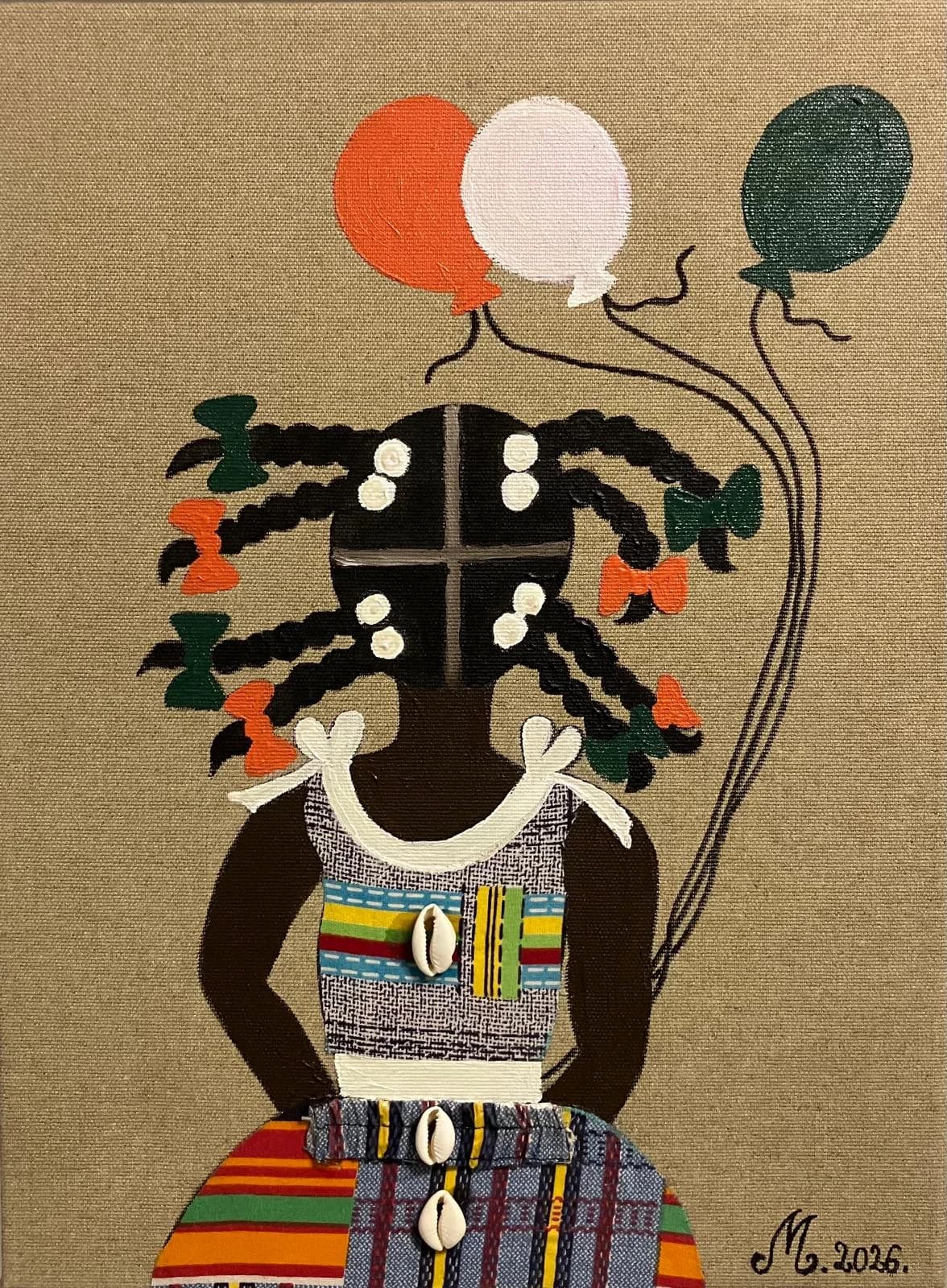


Daughter of August 7th, 1960
A young Ivorian girl is adorned in traditional textiles and cauri shells—small sea shells tied to adornment and cultural identity. Her braided hair and the balloons she holds reflect the colors of the national flag—orange, white, and green. Referencing Côte d’Ivoire’s independence on August 7, 1960, marking its liberation from French colonial rule, the work moves beyond portraiture. The child becomes a quiet symbol of a nation’s beginning—carrying innocence, resilience, and the promise of self-determination.

Muriel Elmaleh
Muriel Elmaleh is a contemporary artist whose work moves between abstract expression, dark pop imagery, and emotionally charged symbolism. Working primarily with acrylic on canvas, she explores themes of identity, nostalgia, emotional tension, and modern psychological survival through color, gesture, distortion, and contrast. Her practice balances spontaneity with restraint — shifting between dense, immersive compositions and quieter minimalist works influenced by abstract expressionism and musical structure. Across both abstract and figurative pieces, familiar imagery is often reinterpreted through darker emotional undertones, transforming childhood icons, cultural references, and symbolic forms into reflections on performance, dependency, exhaustion, and transformation. Influenced in part by her childhood in Ivory Coast, Elmaleh’s work also carries traces of memory, cultural storytelling, and emotional inheritance, sometimes expressed through bold palettes, simplified forms, and African-inspired visual language. Self-taught and instinct-driven, Elmaleh approaches painting as an intuitive and physical act — guided by rhythm, emotion, and the tension between surface and what lies beneath it.
Muriel Elmaleh is a contemporary artist whose work moves between abstract expression, dark pop imagery, and emotionally charged symbolism. Working primarily with acrylic on canvas, she explores themes of identity, nostalgia, emotional tension, and modern psychological survival through color, gesture, distortion, and contrast. Her practice balances spontaneity with restraint — shifting between dense, immersive compositions and quieter minimalist works influenced by abstract expressionism and musical structure. Across both abstract and figurative pieces, familiar imagery is often reinterpreted through darker emotional undertones, transforming childhood icons, cultural references, and symbolic forms into reflections on performance, dependency, exhaustion, and transformation. Influenced in part by her childhood in Ivory Coast, Elmaleh’s work also carries traces of memory, cultural storytelling, and emotional inheritance, sometimes expressed through bold palettes, simplified forms, and African-inspired visual language. Self-taught and instinct-driven, Elmaleh approaches painting as an intuitive and physical act — guided by rhythm, emotion, and the tension between surface and what lies beneath it.


