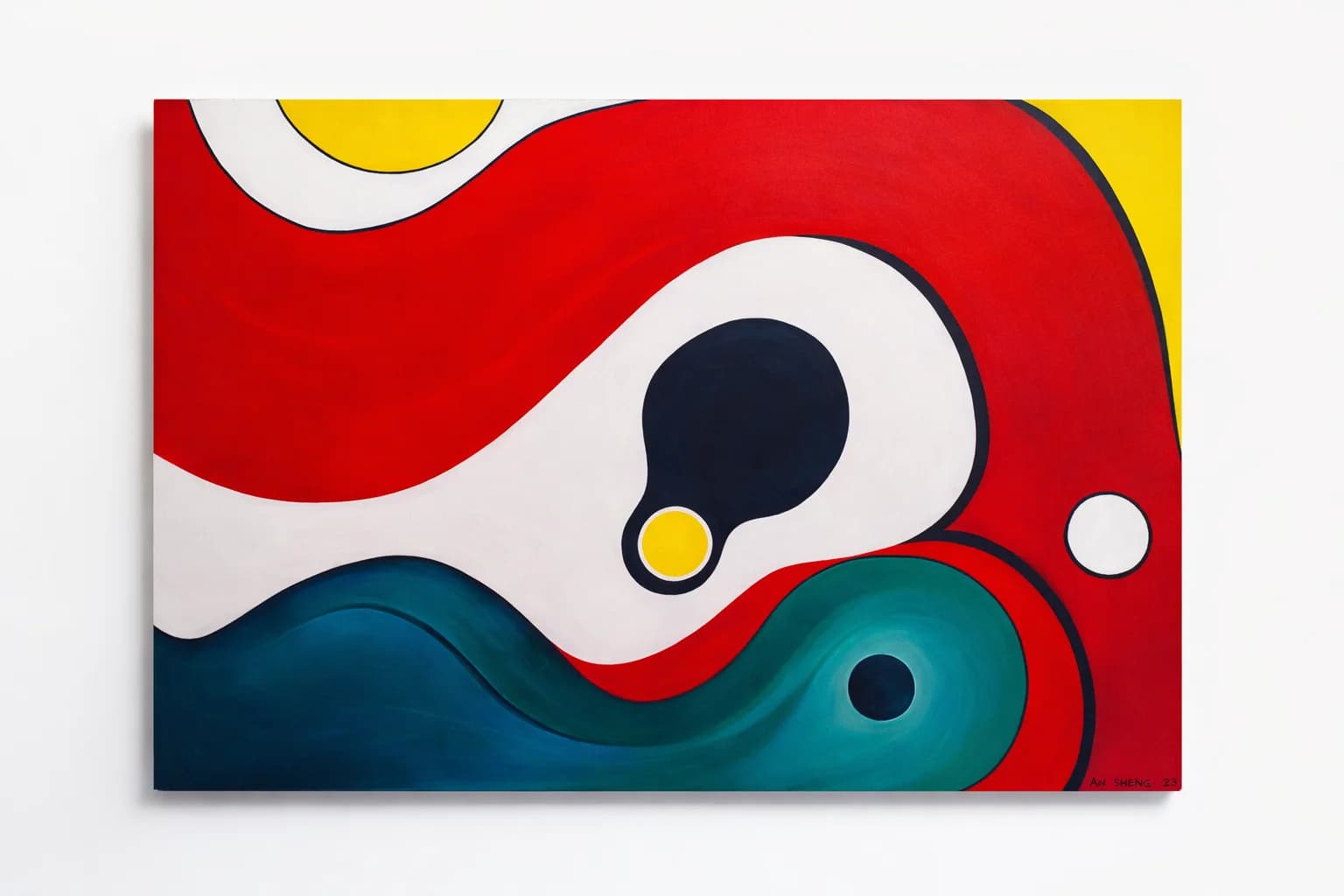
Equilibrium in Motion
A fluid interplay of color and form unfolds across the canvas, where bold red currents wrap around softer, organic shapes in cream, deep navy, and teal. Circular elements—like suspended suns or quiet focal points—punctuate the composition, suggesting moments of pause within continuous flow. The painting balances tension and harmony: sharp outlines contain movement, while gradients and curves soften it. It evokes a sense of inner negotiation—between control and release, structure and instinct—captured in a visual language that feels both dynamic and meditative.

Rozi Vitebsky
Rozi Vitebsky is an architect and visual artist based in Haifa, following several years of living and working in Tel Aviv. Trained in architecture and urban planning, she works on complex planning and urban renewal projects alongside an active and ongoing painting practice. Her architectural background is clearly embedded in her work: grid-based compositions, repetitive tile patterns, checkerboard floors, and urban window frames create structured settings in which emotional narratives unfold. The recurring motif of the vase functions at times as a body or a charged vessel, almost anthropomorphic, positioned against bold decorative backdrops that heighten the tension between depth and flatness. Alongside structural precision and spatial awareness, her paintings reveal an intimate psychological layer: female figures in domestic interiors, direct gazes, and moments of vulnerability or inwardness. She lives with two cats, whose quiet presence subtly echoes in the domestic atmosphere of her work. For Rozi, painting is a space where identity, memory, and presence can be deconstructed and reassembled. Her works are presented on digital platforms and held in private collections.
Rozi Vitebsky is an architect and visual artist based in Haifa, following several years of living and working in Tel Aviv. Trained in architecture and urban planning, she works on complex planning and urban renewal projects alongside an active and ongoing painting practice. Her architectural background is clearly embedded in her work: grid-based compositions, repetitive tile patterns, checkerboard floors, and urban window frames create structured settings in which emotional narratives unfold. The recurring motif of the vase functions at times as a body or a charged vessel, almost anthropomorphic, positioned against bold decorative backdrops that heighten the tension between depth and flatness. Alongside structural precision and spatial awareness, her paintings reveal an intimate psychological layer: female figures in domestic interiors, direct gazes, and moments of vulnerability or inwardness. She lives with two cats, whose quiet presence subtly echoes in the domestic atmosphere of her work. For Rozi, painting is a space where identity, memory, and presence can be deconstructed and reassembled. Her works are presented on digital platforms and held in private collections.


