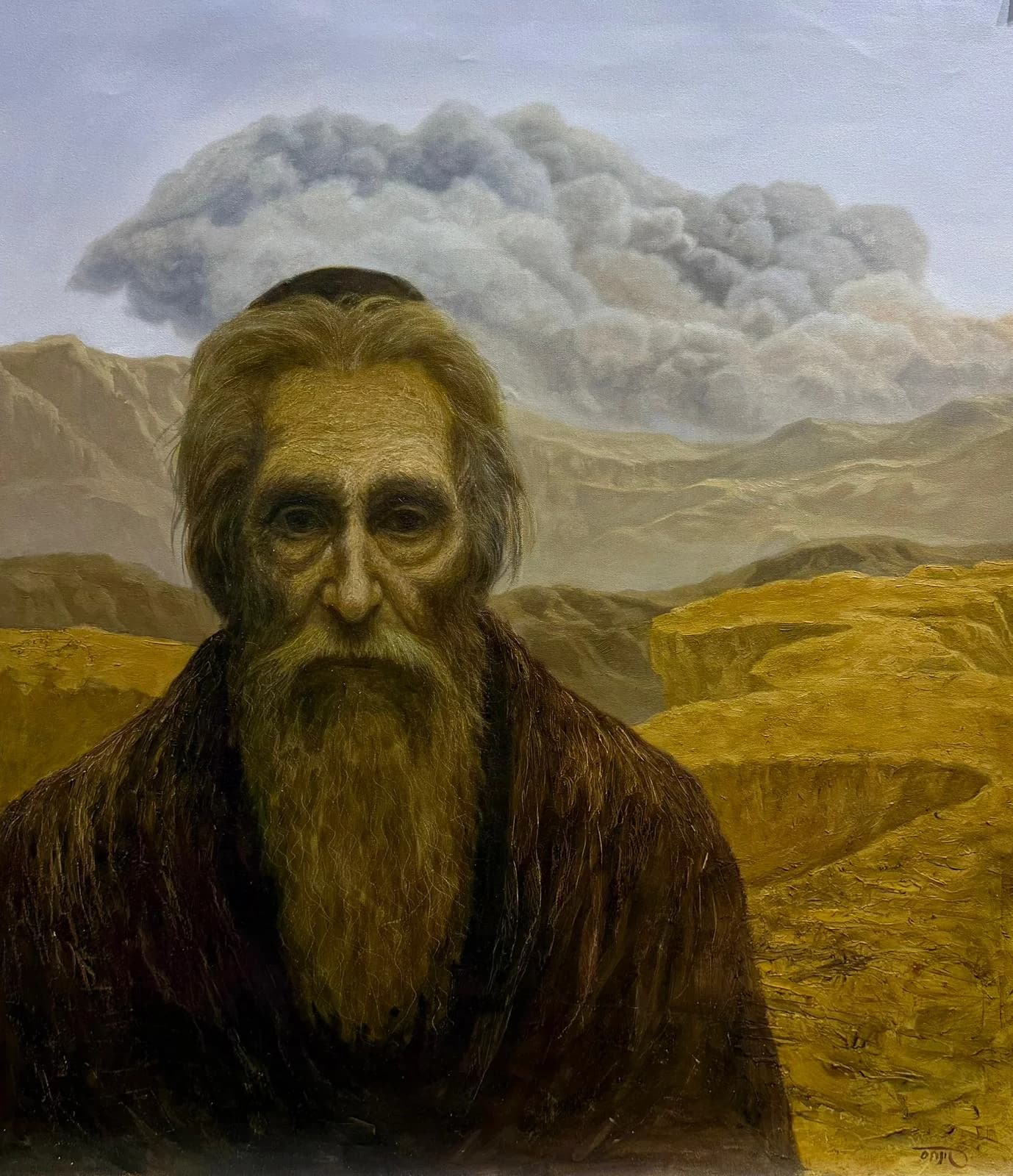
He Looked Back No More
In the aftermath of destruction, Lot stands alone—stripped of home, of certainty, and of all that once defined his world. Behind him lies Sodom, reduced to memory and ash; before him, an uncertain and desolate path. The silence is overwhelming, broken only by the echo of what has been lost. His gaze is fixed forward, not by choice alone, but by necessity—carrying the burden of survival and the cost of obedience. This work captures a moment suspended between judgment and continuation, where loss is absolute, and yet life must go on.

Pinchas Eliyahu
Born in Havana in 1975, the artist grew up in a complex environment where art served both as an escape and a form of expression within a politically restrictive reality. At the age of 10, his exceptional talent was recognized by his teachers, who recommended him for a special program for gifted students. Through this, he received government funding for his artistic education, allowing him to develop his skills from a young age. Despite these opportunities, life in Cuba was far from easy. The communist system limited his freedom of expression, and for many years he was forced to create works based on clients’ demands rather than his own artistic vision, driven mainly by the need to support his family. What began as a deeply personal and liberating form of expression often became simply a means of survival. A turning point came when authorities attempted to recruit his son into the military. Determined to protect his family and seek a freer future, he made the courageous decision to flee Cuba. After a difficult journey, he arrived in Israel and eventually settled in Jerusalem—a city that would become a powerful new source of inspiration. In Jerusalem, he developed a profound connection to spirituality, tradition, and Jewish identity. His artistic work underwent a significant transformation, increasingly exploring themes of faith, memory, community, and cultural heritage. At the same time, he remained committed to social and socialist themes, reflecting both his past in Cuba and his present life in Israel. Today, his art represents a unique fusion of worlds—Cuba and Jerusalem, struggle and freedom, material reality and spiritual depth. No longer driven solely by necessity, his work now reflects a conscious and passionate pursuit of meaning, aiming to inspire thought and foster cultural and human connection.
Born in Havana in 1975, the artist grew up in a complex environment where art served both as an escape and a form of expression within a politically restrictive reality. At the age of 10, his exceptional talent was recognized by his teachers, who recommended him for a special program for gifted students. Through this, he received government funding for his artistic education, allowing him to develop his skills from a young age. Despite these opportunities, life in Cuba was far from easy. The communist system limited his freedom of expression, and for many years he was forced to create works based on clients’ demands rather than his own artistic vision, driven mainly by the need to support his family. What began as a deeply personal and liberating form of expression often became simply a means of survival. A turning point came when authorities attempted to recruit his son into the military. Determined to protect his family and seek a freer future, he made the courageous decision to flee Cuba. After a difficult journey, he arrived in Israel and eventually settled in Jerusalem—a city that would become a powerful new source of inspiration. In Jerusalem, he developed a profound connection to spirituality, tradition, and Jewish identity. His artistic work underwent a significant transformation, increasingly exploring themes of faith, memory, community, and cultural heritage. At the same time, he remained committed to social and socialist themes, reflecting both his past in Cuba and his present life in Israel. Today, his art represents a unique fusion of worlds—Cuba and Jerusalem, struggle and freedom, material reality and spiritual depth. No longer driven solely by necessity, his work now reflects a conscious and passionate pursuit of meaning, aiming to inspire thought and foster cultural and human connection.


